
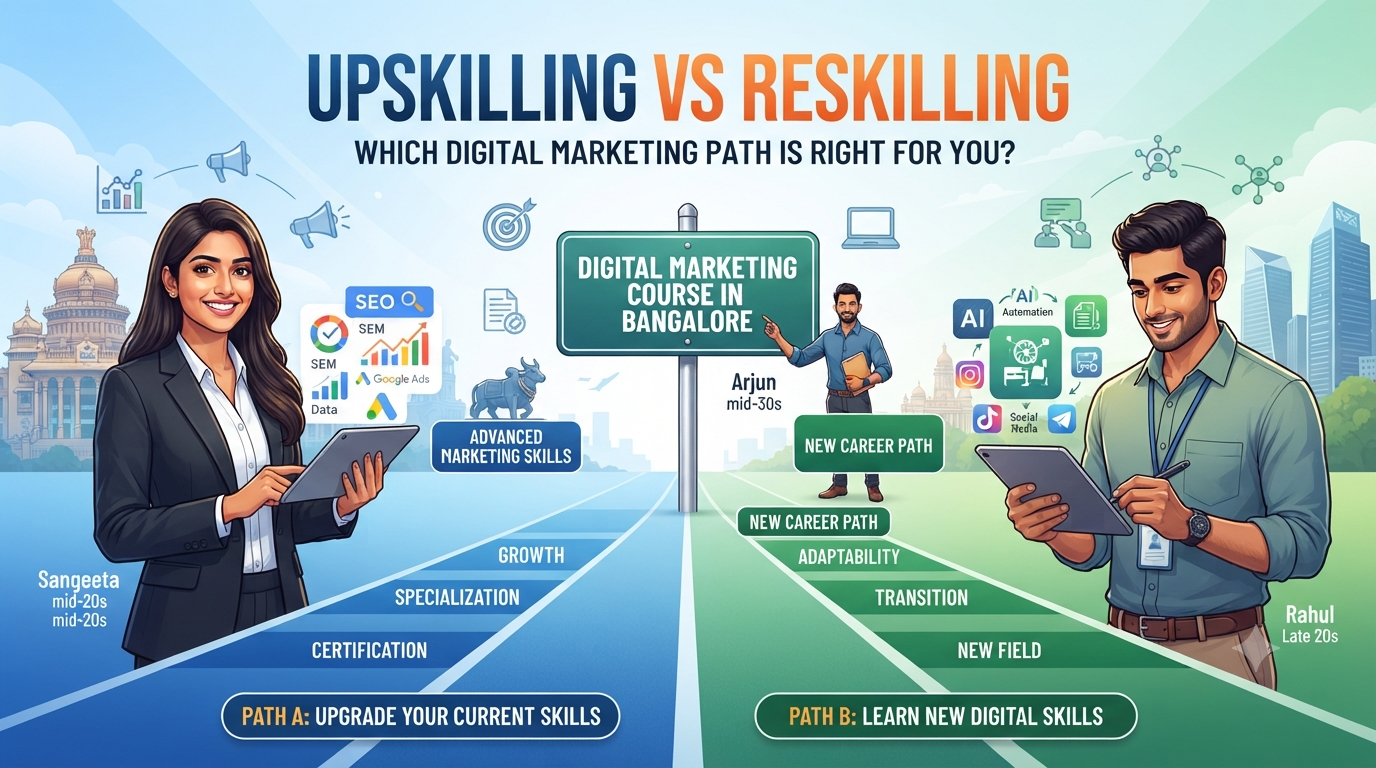

The modern professional workspace is evolving continuously. Changing market demands, shifting business models, and the integration of new technologies mean professionals frequently evaluate how to stay relevant and competitive. Whether you are an entry-level graduate planning your next career step or an experienced specialist looking to adapt, identifying the right professional development strategy is essential.
To stay competitive, professionals often look at two primary concepts: upskilling and reskilling. While both strategies support career growth, choosing the right path—and pairing it with practical expertise—can help you achieve your professional goals. For professionals in India’s tech hub, enrolling in a structured Digital Marketing Course in Bangalore provides a practical way to build relevant, applied skills for modern business needs.
Table of Contents
ToggleUnderstanding the Core Difference: Upskilling vs. Reskilling
Before exploring how digital marketing fits into these strategies, it is helpful to understand the definitions and goals of upskilling versus reskilling.
What is Upskilling?
Upskilling involves learning new, advanced skills within your current domain or profession. It is about vertical growth—deepening your technical capabilities so you can handle more complex responsibilities, improve efficiency, or qualify for advanced roles.
- • The Goal: To optimize your current performance and expand your value within your existing field.
- • Example: A content writer learning advanced SEO and content analytics to transition into a Senior Growth Marketing role.
What is Reskilling?
Reskilling involves learning an entirely new set of skills to transition into a different job role or industry altogether. It focuses on horizontal growth and adaptability, often chosen by professionals seeking a career pivot.
- The Goal: To build a completely new competency set and enter a different professional domain.
- Example: A sales professional learning performance marketing and data analytics to move into a digital advertising role.
Upskilling vs. Reskilling: Quick Comparison
The table below highlights the key differences between the two approaches:
| Upskilling | Reskilling |
| Builds on your existing career | Helps you move into a new career |
| Deepens existing expertise | Develops a new skill set |
| Usually supports career progression | Usually supports career transition |
| Example: SEO executive → SEO/Growth specialist | Example: Sales professional → Performance marketer |
Why Digital Marketing is a Practical Skill Area
Digital marketing has become an important skill set for businesses that rely on online channels for customer acquisition, engagement, and sales. Organizations of varying sizes—from growing startups to established enterprises—utilize digital channels to reach target audiences.
Because modern business relies heavily on online visibility, professionals who understand Search Engine Optimization (SEO), paid advertising, social media management, and data analytics can contribute effectively to business growth. Gaining familiarity with these tools through targeted programs, such as Digital Marketing training in Banashankari, helps professionals acquire practical competencies applicable across multiple industries.
The Role of Upskilling for Marketing and Sales Professionals
For individuals already working in marketing, sales, communications, or media, upskilling provides a way to adapt to evolving industry practices and avoid career plateaus.
Marketing practices have evolved from intuitive approaches to data-informed strategies. Understanding metrics like customer acquisition cost, campaign attribution, and analytical reporting allows professionals to execute more targeted campaigns.
- • Adapting to Digital Tools: Learning how to leverage marketing software and analytics platforms helps professionals streamline campaigns and interpret performance data accurately.
- • Supporting Career Progression: Professionals who expand their technical capabilities are often better positioned for expanded responsibilities or leadership opportunities within their teams.
The Power of Reskilling for Career Changers
For professionals looking to transition from traditional sectors into digital-focused roles, reskilling offers a structured path toward a new career direction.
- • Leveraging Transferable Skills: Communication, analytical thinking, and project management learned in previous roles remain valuable when moving into digital environments.
- • Exploring Diverse Roles: Reskilled professionals can explore various pathways such as SEO specialist, performance marketer, social media strategist, or content manager.
For individuals seeking structured learning environments with mentorship, enrolling in a recognized Digital Marketing training institute in BTM layout can help streamline the transition process through guided, hands-on practice.
Why Industry-Ready Skills Matter in Digital Marketing
Both formal education and practical training serve distinct purposes in professional development. While academic degrees establish foundational knowledge and critical thinking skills, practical training programs focus on contemporary tools, industry workflows, and real-world execution.
In fields like digital marketing, platforms, algorithms, and best practices update regularly. Professionals benefit from hands-on exposure to current software—such as analytics dashboards, ad managers, and SEO auditing tools—allowing them to apply concepts directly to live scenarios.
Should You Upskill or Reskill?
Evaluating your current professional background and career goals can help determine which path fits your needs:
Choose upskilling if:
- You already work in marketing, sales, content, or communications.
- You want to secure a promotion or take on expanded responsibilities.
- You want to add digital marketing capabilities to your existing professional profile.
Consider reskilling if:
- You want to make a deliberate career transition into a new field.
- Your current role offers limited scope for growth or changing industry relevance.
- You want to move into specialized areas like SEO, paid advertising, social media, or performance marketing.
Navigating Your Learning Journey with Digital Marketing Catalyst
For professionals considering either upskilling or reskilling, a practical digital marketing program can provide structured learning across SEO, paid advertising, social media, analytics, and content marketing.
At Digital Marketing Catalyst, our training programs are designed to combine conceptual learning with practical execution. We support students and career changers through structured curriculum modules, hands-on tool practice, and dedicated career support services, including resume-building guidance, mock interviews, and interview preparation.
Explore Digital Marketing Courses at Digital Marketing Catalyst
Conclusion
The choice between upskilling and reskilling depends on your professional background and career objectives. If your goal is to enhance your current role, upskilling provides the necessary depth. If you are looking for a complete career pivot, reskilling offers a clear pathway.
Digital marketing serves as one practical skill area professionals can consider when they want to expand their current capabilities or transition into a new career. Evaluating your options carefully will help you choose the right learning path for your professional growth.
What is the main difference between upskilling and reskilling?
Upskilling involves learning advanced skills within your current profession to improve performance and career progression. Reskilling means learning an entirely new skill set to transition into a different job role or industry.
Can professionals from non-marketing backgrounds learn digital marketing?
Yes. Digital marketing combines analytical thinking, strategic planning, and creative execution, making it accessible to individuals from diverse educational and professional backgrounds with proper guidance.