
Latest SEO Strategies to Improve Google Rankings
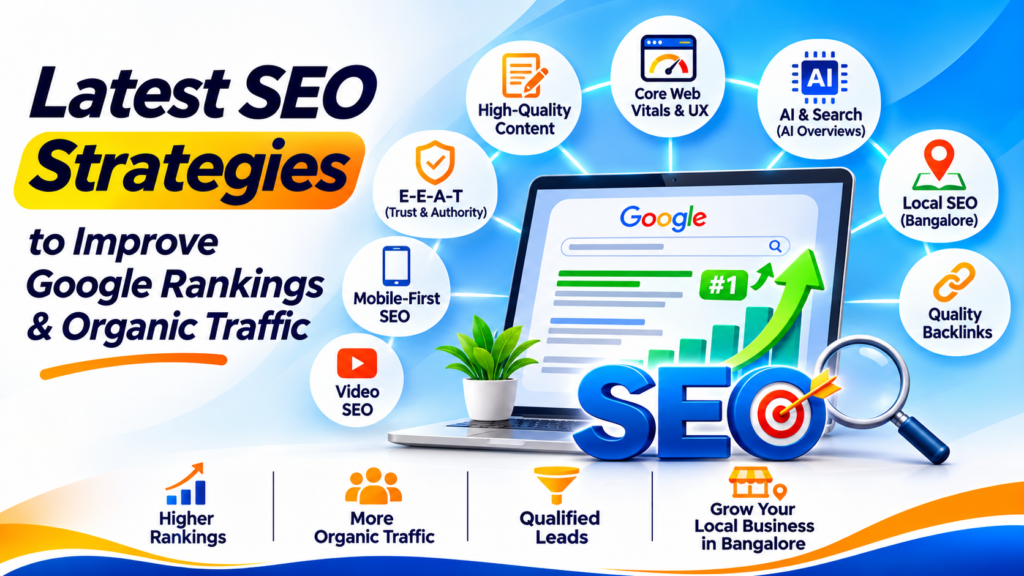
Latest SEO Strategies to Improve Website Rankings and Organic Traffic Search engine optimization has changed significantly over the years. Earlier, businesses could improve their Google rankings by targeting a few keywords, building backlinks and publishing regular blog posts. Today, achieving sustainable organic visibility requires a much more complete approach. Google’s search systems have become better at understanding what users are looking for, evaluating content quality and identifying useful information. At the same time, AI-powered search experiences are changing how people discover businesses, products and services. For businesses in Bangalore and across India, SEO is no longer just about getting website visitors. It is about attracting the right audience, building trust, answering customer questions and converting organic traffic into genuine enquiries. Whether you operate a local business, an e-commerce website, a startup or a B2B company, understanding the latest SEO strategies can help you build a stronger online presence. In this guide, we will explore practical SEO techniques, current search trends, useful tools and actionable examples that businesses can implement to improve their organic search performance. What Is SEO and Why Is It Important for Businesses? Search Engine Optimization (SEO) is the process of improving a website’s visibility in unpaid search engine results. It involves optimizing website content, technical performance, site structure and online credibility so that search engines can understand and present relevant pages to users. For example, imagine someone in Bangalore searches for “best digital marketing agency in Bangalore“. If your agency offers these services and has a well-optimized website, relevant content and strong online credibility, your website has an opportunity to appear in the search results. SEO helps businesses: Increase organic website traffic without paying for every click. Reach people actively searching for their products or services. Generate enquiries and qualified business leads. Build brand awareness and online credibility. Reduce long-term dependence on paid advertising. Reach customers in specific cities, neighbourhoods and service areas. However, SEO is a long-term process. Rankings depend on competition, website quality, search intent, relevance and many other factors. There is no guaranteed method of achieving the first position on Google. Latest SEO Strategies Every Business Should Follow 1. Create Helpful, People-First Content Content quality remains one of the most important parts of a successful SEO strategy. Publishing articles simply to include keywords is unlikely to provide long-term value. Instead, your content should solve real problems, answer relevant questions and help readers make informed decisions. For example, a digital marketing agency in Bangalore can publish an article titled “How Much Does Google Ads Management Cost in Bangalore?” Rather than writing a generic introduction about Google Ads, the article could explain: What determines Google Ads management fees? How does the advertising budget differ from agency fees? What industries benefit from Google Ads? How should a business evaluate campaign performance? What should a company check before hiring an agency? This approach gives readers useful information while naturally introducing your services. Practical recommendations: Understand the questions your target audience asks. Include real examples and practical explanations. Avoid unnecessary introductions and repetitive paragraphs. Add relevant images, screenshots, tables and examples. Update outdated statistics, links and recommendations. Include clear author information and credible references. The objective should be to publish something genuinely more useful than the existing search results. 2. Optimize Content for Search Intent Keyword research is not just about finding phrases with high search volume. You must understand why someone is searching for a particular keyword. Search intent generally falls into four categories: Informational intent: Users want to learn something. Example: What is SEO and how does it work? Navigational intent: Users want to find a particular website or brand. Example: Digital Marketing Catalyst. Commercial investigation: Users are comparing services or evaluating options. Example: Best SEO agencies in Bangalore. Transactional intent: Users are ready to take action. Example: Hire an SEO agency in Bangalore. A common SEO mistake is targeting informational keywords on service pages or trying to sell services through articles that should primarily educate readers. How to implement this strategy: Before creating content, search your target keyword on Google and study the results. Look at: The type of pages ranking on the first page. The questions people are asking. Related searches and suggested queries. Whether searchers expect a guide, comparison, service page or tutorial. Create a page that satisfies the actual requirement behind the search. 3. Optimize for AI-Powered Search and AI Overviews Search is evolving beyond traditional blue links. AI-powered experiences, including Google’s AI Overviews and AI Mode, can help users explore complex questions and discover relevant websites. This creates another opportunity for businesses to become visible through useful, trustworthy and well-structured content. However, there is no separate secret SEO technique or special schema that guarantees visibility in AI search results. Strong traditional SEO fundamentals remain important. Strategies to improve your content’s visibility: Answer important questions clearly and directly. Use descriptive headings that explain each section. Include original examples, research and practical insights. Support factual claims with reliable sources. Explain complex subjects using simple language. Keep important information accessible as text. Build a clear internal linking structure. Ensure your pages are crawlable and indexable. For example, instead of writing only “SEO is important for businesses”, explain how a Bangalore-based real estate company can use local landing pages, informative property guides and Google Business Profile optimization to attract relevant enquiries. Specific explanations provide more value than generic statements. 4. Strengthen E-E-A-T: Experience, Expertise, Authoritativeness and Trustworthiness Google’s quality guidelines emphasize experience, expertise, authoritativeness and trustworthiness, commonly referred to as E-E-A-T. E-E-A-T is not a single ranking factor or a score that you can improve through a plugin. It is a useful framework for evaluating whether your website demonstrates credibility and provides reliable information. How to demonstrate E-E-A-T: Experience: Include practical examples, screenshots, project experiences and observations wherever possible. Expertise: Publish detailed content that demonstrates knowledge of your subject. Authoritativeness: Build recognition through relevant industry mentions, quality backlinks and credible contributions. Trustworthiness: Provide accurate information, transparent business details, contact information and genuine customer feedback. For
Basics of Digital Marketing: Introduction for Beginners
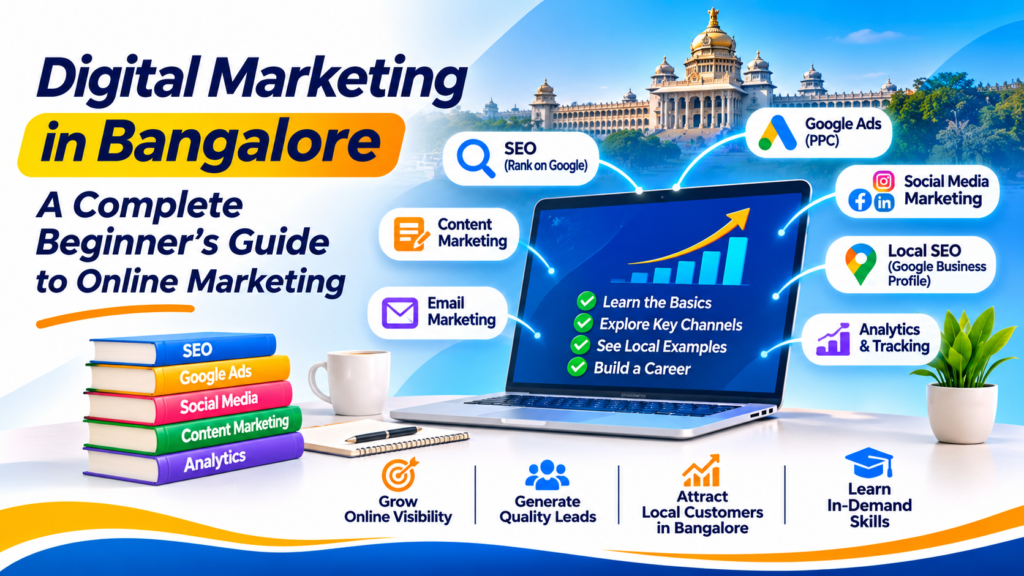
Digital Marketing in Bangalore: A Complete Beginner’s Guide to Online Marketing The way businesses reach customers has changed significantly over the last few years. People no longer depend only on newspaper advertisements, television commercials or traditional marketing to discover products and services. Today, customers search on Google, explore Instagram, watch YouTube videos, compare websites and read online reviews before making purchasing decisions. This change has made digital marketing an important part of business growth. Whether you run a small business in Bangalore, manage a company, operate an online store or want to build a career in marketing, understanding digital marketing can open up several opportunities. For example, someone looking for a home renovation company in Bangalore might search Google for “home renovation services near me”. A student looking for professional training might search for “digital marketing courses in Bangalore“. A restaurant owner might use Instagram and Google Business Profile to attract customers from nearby areas. All these activities are connected to digital marketing. But what exactly is digital marketing? Which channels should businesses use? How do SEO, Google Ads and social media marketing work together? And how can beginners get started? In this guide, we will explain the fundamentals of digital marketing, its major components, practical business applications, local marketing strategies and the skills required to build a career in this field. What Is Digital Marketing? Digital marketing is the process of promoting products, services or brands through internet-based channels and digital technologies. It includes activities such as improving website visibility on search engines, running paid advertisements, publishing useful content, managing social media accounts, sending email campaigns and analyzing website performance. Unlike traditional advertising, digital marketing allows businesses to reach specific audiences, measure campaign performance and make adjustments based on customer behaviour. For example, consider a business providing house construction services in Bangalore. Instead of depending entirely on newspaper advertisements or referrals, the company can: Create a website explaining its construction services. Optimize its website for searches such as “house construction company in Bangalore”. Run Google Search Ads to reach people actively looking for construction services. Publish construction-related videos and posts on Instagram. Share customer testimonials and completed project photographs. Track enquiries through website forms and WhatsApp. Analyze which marketing channels generate qualified enquiries. This is how businesses use digital marketing to improve their online visibility and generate potential customers. Why Is Digital Marketing Important for Businesses in Bangalore? Bangalore is home to technology companies, startups, educational institutions, healthcare providers, restaurants, real estate businesses, retail stores and professional service providers. Customers in the city regularly use online platforms to discover and compare businesses before contacting them. For local businesses, having an online presence is no longer just an additional marketing activity. It can become an important source of enquiries and customer acquisition. Here are some reasons why digital marketing matters. 1. Reach Customers Who Are Already Searching People often search online when they need a particular product or service. For example: Best digital marketing agency in Bangalore SEO services in Bangalore Interior renovation company near me Best coaching institute in Bangalore Property management companies in Bangalore With an effective SEO and advertising strategy, businesses can improve their chances of appearing when potential customers search for relevant services. 2. Generate Local Business Enquiries A local business does not always need to target an entire city. A dental clinic in Jayanagar, for example, may primarily want to reach people living or working around Jayanagar, JP Nagar and Banashankari. Similarly, a restaurant in Indiranagar may focus its local marketing activities on customers in nearby neighbourhoods. Google Business Profile, local SEO and location-focused advertising can help businesses reach relevant audiences. 3. Measure Marketing Performance One of the major advantages of digital marketing is the ability to measure results. Businesses can monitor: Website visitors. Search impressions and clicks. Advertising expenditure. Cost per click. Number of enquiries. Cost per lead. Conversion rates. Qualified leads. Sales generated. This information helps businesses understand which marketing activities are contributing to their objectives. 4. Build Brand Awareness and Customer Trust Customers often research a company before contacting it. A professional website, useful blog articles, active social media profiles, customer testimonials and genuine reviews can help establish credibility. Consistent communication also helps businesses remain visible to potential customers. What Are the Different Types of Digital Marketing? Digital marketing includes several channels. Each channel serves a different purpose, and businesses can combine them depending on their target audience, objectives and budget. Let’s understand the major components. 1. Search Engine Optimization (SEO) Search Engine Optimization, commonly known as SEO, is the process of improving a website’s visibility in organic search engine results. When someone searches Google for a product, service or answer, Google displays relevant results based on its search systems. SEO helps businesses make their websites easier for search engines and visitors to understand. For example, a company offering SEO services in Bangalore may want its website to appear when someone searches for “SEO agency in Bangalore“. To improve its search visibility, the company can work on several SEO activities. Important areas of SEO include: Keyword Research: Finding the search terms potential customers use when looking for products or services. On-Page SEO: Optimizing page titles, headings, descriptions, URLs, internal links and website content. Technical SEO: Improving website crawlability, indexing, mobile usability, page performance and technical structure. Off-Page SEO: Building the website’s reputation through relevant backlinks, brand mentions and other legitimate online references. Local SEO: Improving visibility for location-based searches through relevant website content and Google Business Profile. Content Marketing: Publishing helpful articles, guides and resources that answer customer questions. Practical Bangalore SEO Example Imagine a company providing facility management services to apartments, hospitals, malls and corporate offices in Bangalore. Rather than publishing generic articles about facility management, the company can create useful content around specific customer requirements: Facility Management Companies in Bangalore. Facility Management Services for Apartments. Commercial Building Maintenance Services. Integrated Facility Management for Hospitals. Housekeeping Services for Corporate Offices. These pages and articles should explain the actual services, processes,
How to Use Artificial Intelligence in Digital Marketing
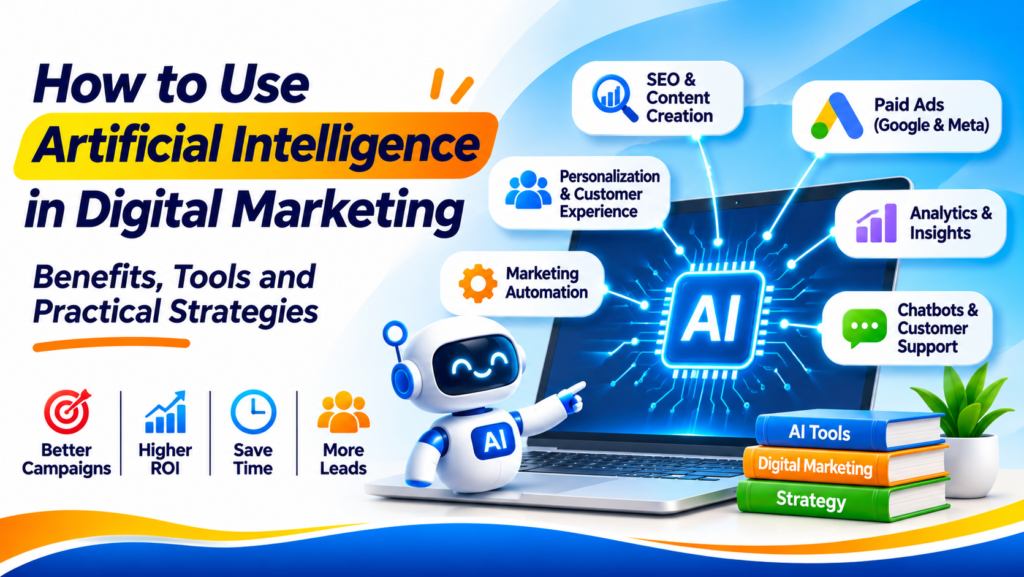
How to Use Artificial Intelligence in Digital Marketing: Benefits, Tools and Practical Strategies Artificial Intelligence (AI) is changing the way businesses approach digital marketing. From understanding customer behaviour to creating advertising campaigns, analyzing website performance and automating repetitive tasks, AI is helping marketing teams work more efficiently and make better-informed decisions. Earlier, digital marketers spent considerable time researching keywords, writing content, analyzing campaign reports and managing customer enquiries. Today, AI-powered tools can assist with many of these activities, allowing marketers to spend more time on strategy, creativity and business growth. However, using AI in digital marketing is not simply about generating content or automating advertisements. The real value comes from knowing where to use AI, how to interpret its recommendations and when human expertise is necessary. Whether you run a small business, manage a marketing team or work as a digital marketing professional, understanding how to use artificial intelligence in digital marketing can help you improve your marketing processes and reach potential customers more effectively. In this article, we will explore the major benefits of AI in digital marketing, practical applications, popular AI tools, real-world marketing scenarios and important considerations businesses should understand before adopting AI. What Is Artificial Intelligence in Digital Marketing? Artificial Intelligence in digital marketing refers to the use of AI technologies to analyze information, identify patterns, generate insights, automate activities and support marketing decisions. These technologies can process large amounts of information and help marketers understand what customers are looking for, which campaigns are performing well and what improvements may be worth testing. For example, an online business running Google Ads can use AI-powered campaign features to identify relevant search queries and optimize advertising assets. An SEO professional can use AI tools to organize keyword research and identify content opportunities. A customer support team can use AI chatbots to respond to frequently asked questions. AI does not replace the need for marketing knowledge. It gives marketers additional capabilities to perform their work more efficiently. Top Benefits of Artificial Intelligence in Digital Marketing 1. Improved Customer Experience and Personalization Customers expect businesses to understand their needs and provide relevant information. Generic marketing messages often fail to attract attention because they do not address individual interests. AI can help businesses understand customer behaviour by analyzing available information such as browsing activity, previous purchases, product interests and engagement patterns. Based on these insights, businesses can develop more relevant marketing messages and customer experiences. For example: An e-commerce website can recommend products based on browsing and purchase behaviour. An educational institution can share course information based on a visitor’s interests. A real estate company can provide property information based on a customer’s preferred location and budget. A service business can send relevant follow-up messages based on the service a customer has enquired about. Personalization should always respect customer privacy and applicable data protection requirements. The objective is to make the customer journey more useful rather than simply sending more marketing messages. 2. Optimized Digital Advertising Campaigns Advertising platforms increasingly use artificial intelligence to improve campaign delivery, targeting and creative optimization. This is particularly relevant for businesses investing in Google Ads and Meta Ads. AI in Google Ads Google Ads uses AI-powered features to assist advertisers with campaign optimization. For example, AI Max for Search campaigns provides features such as search term matching, text customization and Final URL expansion. These features help advertisers explore relevant searches and adapt advertising messages to customer intent. Marketers still need to monitor search terms, conversion tracking, landing pages, budgets and lead quality. AI in Meta Ads Meta’s Advantage+ suite uses AI and automation to support advertising optimization across areas such as audience, placements and budgets. This can help advertisers test and deliver campaigns more efficiently. For example, a business promoting home maintenance services can use Meta Ads to reach potential customers and evaluate which campaign combinations generate enquiries. However, getting more leads does not automatically mean getting better leads. Marketing teams must evaluate whether enquiries are relevant and whether they convert into customers. How marketers can use AI in advertising: Generate different advertising copy variations. Explore potential audience segments. Analyze campaign performance. Identify opportunities for creative testing. Support automated bidding and campaign optimization. Improve advertising message relevance. Analyze conversion trends. AI can improve campaign efficiency, but human supervision is still important for budget allocation, business objectives and advertising strategy. 3. Faster Content Creation and Content Planning Content marketing is an important part of digital marketing, but consistently producing useful content requires research, planning and editing. AI-powered content tools can help marketers speed up different stages of content production. For example, marketers can use AI to: Generate blog topic ideas. Prepare article outlines. Identify frequently asked customer questions. Create social media content drafts. Develop email marketing subject lines. Prepare product description drafts. Repurpose long-form content into shorter posts. Improve grammar and readability. Consider a digital marketing agency planning its monthly content calendar. Instead of starting every topic from scratch, the marketing team can use AI to brainstorm relevant topics, group them by search intent and create an initial publishing schedule. The team can then add its own experience, research, examples and recommendations. Important: AI-generated content should not be published without reviewing its accuracy, originality and usefulness. Google recommends creating helpful, reliable, people-first content rather than producing content primarily to manipulate search rankings. 4. Better SEO Research and Search Engine Optimization Search Engine Optimization involves several activities, including keyword research, competitor analysis, technical audits, content optimization and performance monitoring. AI can support many of these activities by helping SEO professionals organize information and identify potential improvements. AI applications in SEO include: Keyword research: AI can suggest related search terms, long-tail keywords and customer questions. Content gap analysis: It can help organize competitor topics and identify subjects that may be missing from your website. Content optimization: AI can assist with improving headings, readability, content structure and keyword relevance. Technical SEO: AI-assisted tools can help interpret website audit findings and explain potential technical issues. Search intent analysis: AI
seo course in bangalore 100% practicals and job support
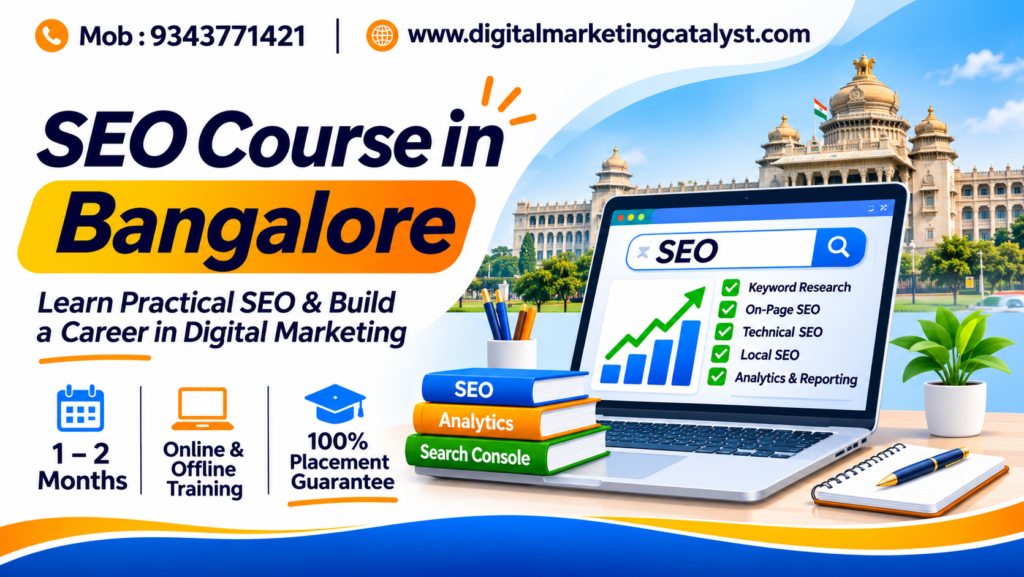
SEO Course in Bangalore – Learn Practical Search Engine Optimization and Build Your Digital Marketing Career Have you ever searched for a product or service on Google and wondered why certain websites appear on the first page while others remain difficult to find? That is where Search Engine Optimization (SEO) plays an important role. Today, businesses depend on their online presence to attract customers, generate enquiries and build brand awareness. Simply creating a website is not enough. Potential customers should be able to discover that website when they search for relevant products, services or information. SEO helps businesses improve their visibility in organic search results and reach people who are actively looking for what they offer. If you want to understand how Google works, how websites rank and how businesses attract organic traffic, learning SEO can be a valuable career skill. Digital Marketing Catalyst (DMC) offers an SEO course in Bangalore designed for learners who want to understand search engine optimization through practical learning and structured training. The course covers keyword research, on-page SEO, off-page SEO, technical SEO, local SEO, content optimization and website performance analysis. The programme duration is 1–2 months, with both online and offline training options. DMC also offers a 100% placement guarantee, subject to the programme’s applicable terms and eligibility conditions. Whether you are a college student, fresher, working professional, freelancer or business owner, this course can help you develop a better understanding of how SEO works in real business situations. Why Learn SEO in Bangalore? Bangalore is home to technology companies, startups, digital marketing agencies, e-commerce businesses and organizations across several industries. Most businesses need an online presence to communicate with customers and promote their products or services. Consider a few examples: A real estate company wants its property listings to appear in relevant Google searches. An e-commerce business wants more organic visitors to its product pages. A restaurant wants to improve its visibility when people search for nearby dining options. A software company wants its service pages to reach potential B2B customers. A training institute wants students to discover its courses through Google. All these businesses can benefit from a well-planned SEO strategy. This creates opportunities for people who understand website optimization, keyword research, content planning and search performance analysis. Learning SEO can help you develop skills that are applicable across different industries rather than being limited to one particular business category. What Is Search Engine Optimization? Search Engine Optimization, commonly known as SEO, is the process of improving a website’s visibility in organic search results. When a person searches on Google, the search engine tries to provide results that are relevant and useful for that particular query. SEO involves improving website content, structure, technical accessibility and overall usefulness so that search engines can better understand the pages and visitors can find the information they need. There are three important stages of Google Search: 1. Crawling Search engines discover website pages by following links and using other discovery methods. 2. Indexing Search engines analyse discovered pages and determine whether they should be included in their search index. 3. Serving search results When a user performs a search, Google uses various systems to select and display relevant results. An SEO professional needs to understand these processes before implementing optimization activities. For example, if an important website page is not indexed, adding more keywords to that page may not solve the problem. You first need to understand why the page is not appearing in Google’s index. What Will You Learn in Our SEO Course in Bangalore? The SEO training programme introduces learners to the major areas of search engine optimization. The objective is to understand not only what each SEO technique means, but also why it is used and how it can be applied to websites. 1. SEO Fundamentals and Google Search Every SEO learner should start by understanding how search engines work. You will learn: Introduction to search engine optimization. How Google Search works. Crawling, indexing and ranking. Organic search versus paid advertising. Search engine results pages (SERPs). Search intent. Google Search Essentials. Basic SEO terminology. Understanding these concepts helps you build a strong foundation before moving into advanced website optimization activities. 2. Keyword Research and Competitor Analysis Keyword research is one of the most important activities in SEO. Before creating or optimizing a website page, you need to understand what potential customers are searching for. For example, a company providing digital marketing services in Bangalore may want to target keywords such as: Digital marketing agency in Bangalore. SEO services in Bangalore. Google Ads management services. Social media marketing agency. Website SEO optimization. However, not all keywords have the same search intent. Some users are looking for information, while others are comparing service providers or are ready to make an enquiry. You will learn: Primary and secondary keyword research. Short-tail and long-tail keywords. Search volume and keyword difficulty. Informational search intent. Commercial search intent. Transactional search intent. Competitor keyword analysis. Keyword mapping. Content gap analysis. Practical exercise: Choose a business category, research relevant keywords and organize them according to their search intent. This helps you understand how to select keywords for service pages, product pages and blog articles. 3. On-Page SEO Optimization On-page SEO focuses on improving individual website pages. A website may contain useful information, but poorly written titles, confusing headings and weak internal linking can make the content difficult to understand. You will learn: SEO title writing. Meta description optimization. H1, H2 and H3 heading structure. Natural keyword placement. URL optimization. Image ALT text. Internal linking. Content readability. Search intent optimization. Content structure improvement. You will understand how to optimize website pages without unnecessarily repeating keywords. Practical exercise: Review an existing website page, identify optimization issues and prepare an improved version. 4. Technical SEO Technical SEO focuses on making website content accessible and understandable to search engines. Even a website with useful content can experience SEO problems if important pages cannot be crawled or indexed properly. You will learn about: XML sitemap
SEO Training in Jayanagar 100% practicals and job support
SEO Training in Jayanagar: Learn Practical SEO with 100% Placement Guarantee Are you looking to build a career in digital marketing? Do you want to understand how websites rank on Google, attract organic traffic and generate business enquiries? Search Engine Optimization (SEO) is an important digital marketing skill that helps businesses improve their online visibility and reach potential customers through organic search. If you are searching for SEO training in Jayanagar, Digital Marketing Catalyst (DMC) offers a practical SEO training programme designed for students, freshers, working professionals, freelancers and business owners. The course runs for 1–2 months, with both online and offline training options. The curriculum covers keyword research, on-page SEO, technical SEO, off-page SEO, local SEO, content optimization and website performance analysis. DMC also offers a 100% placement guarantee, subject to the programme’s applicable terms and eligibility conditions. Whether you want to become an SEO executive, work in a digital marketing agency, start freelancing or improve your own business website, learning SEO can help you develop valuable digital marketing skills. In this guide, we will explore the SEO course curriculum, practical training activities, important tools, career opportunities and how to choose the right SEO training institute in Jayanagar. What Is Search Engine Optimization (SEO)? Search Engine Optimization, commonly known as SEO, is the process of improving a website’s visibility in unpaid search engine results. When people search for products, services or information on Google, the search engine displays relevant web pages based on several factors, including relevance, content quality, usefulness and technical accessibility. For example, users may search for: SEO training in Jayanagar Digital marketing course in Jayanagar Best digital marketing agency in Bangalore Website development services in Bangalore SEO course for beginners SEO helps websites become more discoverable for relevant searches and attract visitors who are interested in their products, services or information. Unlike paid advertising, organic search traffic does not require businesses to pay Google for every click. However, SEO requires continuous optimization, quality content, technical improvements and performance monitoring. Why Should You Learn SEO in 2026? Businesses increasingly depend on their websites to attract customers, generate enquiries and establish their online presence. Learning SEO can help you develop practical skills that are useful across different areas of digital marketing. 1. Improve Organic Website Visibility Understand how search engines discover, crawl and index website pages and how businesses can improve their organic search presence. 2. Develop Content Marketing Skills Learn how to research topics, understand search intent and create useful website content that answers customer questions. 3. Understand Local SEO Learn how businesses can improve their visibility in location-based searches and Google Maps. 4. Identify Website Optimization Issues Understand how page structure, internal linking, indexing, mobile usability and website performance affect search visibility. 5. Build Digital Marketing Career Skills SEO knowledge can be applied in digital marketing agencies, e-commerce businesses, startups and organizations managing their own websites. 6. Understand AI-Assisted Search Learn how AI tools can support SEO research, content planning and analysis while maintaining accuracy, originality and useful information. SEO Training in Jayanagar – Course Details Digital Marketing Catalyst offers SEO training options for learners who want to develop search engine optimization knowledge and practical digital marketing skills. Course information Details Course name Search Engine Optimization (SEO) Duration 1–2 months Training mode Online and offline Location focus Jayanagar, Bangalore Learning level Beginner to advanced concepts Curriculum On-page, off-page, technical and local SEO Placement 100% placement guarantee Institute Digital Marketing Catalyst Contact DMC for the current course fees, batch schedule, class timings and applicable placement policy. What Will You Learn in Our SEO Course in Jayanagar? A comprehensive SEO training programme should cover the complete optimization process, from keyword research to website optimization and organic performance analysis. Here are the important topics covered in the SEO learning curriculum. 1. SEO Fundamentals and Search Engine Basics Start by understanding how search engines discover, crawl, index and display web pages. Topics include: What is SEO? How Google Search works Crawling, indexing and ranking Organic search versus paid search Search engine results pages (SERPs) Google Search Essentials Search intent and user behaviour Basic SEO terminology You will understand why certain web pages appear in search results and what website owners should consider when improving their online visibility. 2. Keyword Research and Competitor Analysis Keyword research helps identify the words and phrases people use when searching for information, products and services. Topics include: Primary and secondary keywords Short-tail and long-tail keywords Search volume and keyword difficulty Informational and commercial search intent Transactional and navigational keywords Competitor keyword research Keyword mapping Identifying content opportunities Practical example: Imagine a digital marketing institute wants to reach students searching for courses in Jayanagar. Potential search terms may include: SEO training in Jayanagar SEO classes in Jayanagar Digital marketing course in Jayanagar SEO training in Bangalore Practical SEO course SEO course for beginners After identifying these keywords, you need to understand the search intent behind each one. For example, someone searching for an SEO course is likely looking for course details, curriculum, fees, duration, training options and career support. An effective landing page should answer these questions rather than simply repeat the target keyword. 3. On-Page SEO Optimization On-page SEO involves optimizing the content and HTML elements of individual website pages. Topics include: SEO title optimization Meta description writing H1, H2 and H3 heading structure Keyword placement URL optimization Image SEO and ALT text Internal linking Content readability Search intent optimization Content updates Practical activity: Optimize an existing website page by improving its SEO title, meta description, headings, content structure, image ALT attributes and internal links. 4. Technical SEO Training Technical SEO focuses on making websites accessible, crawlable and understandable to search engines. Important topics include: XML sitemap creation and submission Robots.txt configuration Canonical tags Website crawling and indexing Redirects and broken links HTTPS and website security Mobile usability Core Web Vitals Page speed optimization Structured data and schema markup Duplicate content issues You will learn how to identify common technical SEO problems and understand
SEO Training in JP Nagar 100% practicals and job support
SEO Training in JP Nagar: Learn Practical SEO and Build a Career in Digital Marketing Have you ever wondered why some websites appear on the first page of Google while others struggle to get noticed? It is not always about having a beautiful website. The way a website is structured, the content it publishes, the keywords it targets and the experience it provides to visitors all play a role in search visibility. This is where Search Engine Optimization (SEO) comes in. If you are interested in learning how Google Search works and how businesses attract customers without depending entirely on paid advertisements, SEO is a useful skill to develop. Digital Marketing Catalyst (DMC) offers SEO training for learners in JP Nagar, Bangalore, with a curriculum covering keyword research, website optimization, technical SEO, content development and local search. The course duration is 1–2 months, and learners can choose between online and offline training. DMC also offers a 100% placement guarantee subject to the programme’s applicable terms and eligibility conditions. Whether you are a student exploring career options, a working professional looking to upgrade your skills or a business owner who wants to understand website marketing, this course introduces you to the practical side of SEO. Let’s understand what you will learn and how these skills can be useful in the real world. Why Are Businesses Investing in SEO? Think about a person searching Google for a service they need. They might search for a digital marketing agency, a construction company, a dentist or a training institute. Usually, they are not interested in browsing hundreds of websites. They want to find relevant information, compare their options and contact a suitable business. Businesses want their websites to appear when these searches happen. SEO helps them work towards that visibility. For example, consider a business website offering digital marketing services in Bangalore. Simply publishing a homepage with a list of services may not be enough. The website may need: Separate pages explaining individual services. Useful articles answering customer questions. Relevant keywords based on what potential customers search for. Clear website navigation and internal links. Good mobile usability and page performance. Accurate business information. A technically accessible website that search engines can crawl. These are some of the areas you will explore when learning SEO. The important thing to understand is that SEO is not a one-time activity. Search behaviour, competitors, website content and search engine systems change. Businesses need to review and improve their websites regularly. What Is SEO and How Does Google Search Work? Search Engine Optimization is the process of improving a website so that search engines can discover, understand and display its pages for relevant searches. Google generally works through three important stages: Crawling: Google discovers web pages by following links and using other discovery methods. Indexing: Google analyses the information it finds and decides whether a page is eligible to be included in its search index. Serving search results: When someone searches, Google selects relevant results based on many factors and systems. Learning these fundamentals is important because not every website page automatically appears in Google. For example, if a website has a newly published service page that is not internally linked or has technical indexing issues, Google may have difficulty discovering or indexing it. An SEO professional should know how to investigate such problems instead of simply adding more keywords to the page. What Will You Learn in Our SEO Training in JP Nagar? Our SEO curriculum introduces the important activities involved in improving website visibility. Rather than learning only definitions, students should understand how each SEO activity is used when working on a website. 1. Keyword Research: Understand What People Are Searching For Imagine you are working on the website of a digital marketing training institute. The business wants to reach students who are interested in learning SEO. What should you target? Possible keywords include: SEO training in JP Nagar SEO course in Bangalore Practical SEO classes Digital marketing course for beginners Technical SEO training SEO training with placement Keyword research helps identify relevant search terms and understand why people use them. You will learn: How to identify primary and secondary keywords. How to research long-tail keywords. How to understand keyword search intent. How to compare competitor keywords. How to identify content opportunities. How to map keywords to relevant website pages. How to use keyword research tools. One important lesson is that keywords should match the purpose of a page. Someone searching for an SEO course wants course information. Someone searching for an SEO definition wants an explanation. Creating the right page for each requirement makes a website more useful. 2. On-Page SEO: Make Website Pages More Useful On-page SEO is one of the areas where learners can understand the results of their work quite clearly. Suppose a company has a service page titled “Our Services”. A visitor may not understand what the page offers, and the title provides little context. An SEO professional would review the page and improve its content structure. Topics include: Writing relevant SEO titles. Creating useful meta descriptions. Structuring H1, H2 and H3 headings. Using keywords naturally. Optimizing website URLs. Adding descriptive image ALT text. Improving internal links. Making content easier to read. Matching content with search intent. Reviewing outdated website pages. Practical learning: Work on an existing web page, identify its weaknesses and prepare an improved version with better headings, content, metadata and internal links. 3. Technical SEO: Understand What Happens Behind a Website You may come across websites that look perfectly fine but have problems affecting their search visibility. For example: Important pages are not indexed. Several URLs display duplicate content. Broken links lead visitors to error pages. Website pages take too long to load. Search engines cannot access important resources. The XML sitemap contains incorrect URLs. Technical SEO helps identify and investigate these issues. You will learn about: XML sitemap creation. Robots.txt configuration. Canonical tags. Crawling and indexing. Redirects and broken links. HTTPS and website security. Mobile usability. Core
SEO Training in Girinagar 100% practicals and job support
SEO Training in Girinagar – Learn Practical SEO and Develop In-Demand Digital Marketing Skills A business may have a good website, quality products and excellent services, but how will potential customers find it online? This is one of the biggest challenges businesses face today. Having a website is only the beginning. People need to discover it when they search for relevant products, services or information on Google. Search Engine Optimization (SEO) helps businesses improve their organic search visibility and connect with people who are already looking for what they offer. If you want to understand how websites rank on Google, how keywords are selected and how website content is optimized, learning SEO is a good place to start. Digital Marketing Catalyst (DMC) offers SEO training for learners looking for practical SEO knowledge in Girinagar, Bangalore. The programme covers important areas such as keyword research, on-page optimization, technical SEO, off-page SEO, local SEO and content optimization. The course duration is 1–2 months, with both online and offline training options. DMC also offers a 100% placement guarantee, subject to the programme’s applicable terms and eligibility conditions. Whether you are a fresher, college student, working professional, freelancer or business owner, this course can help you understand how SEO is applied to business websites. Why Is Learning SEO a Valuable Skill? Think about your own Google searches. When you need a service, you probably search for it online, visit a few websites, compare the information and decide which business to contact. Businesses want their websites to appear during these searches. SEO helps them improve their chances of being discovered by relevant audiences. For example, a local business offering website development services may want to appear when someone searches for website development in Bangalore. To work towards that visibility, the business needs more than a few keywords on its homepage. It needs useful service pages, relevant content, a technically accessible website and a clear website structure. This is why SEO professionals work across several areas of digital marketing. Learning SEO can help you understand: How search engines discover and index websites. How people search for products and services. How to select relevant keywords. How to improve website content. How to identify technical SEO problems. How to measure organic search performance. How local businesses can improve their online presence. These skills are useful in digital marketing agencies, startups, e-commerce businesses and organizations managing their own websites. What Is Search Engine Optimization? Search Engine Optimization, commonly known as SEO, is the process of improving a website’s visibility in organic search results. When someone searches on Google, the search engine tries to display pages that are relevant and useful for that particular query. SEO involves improving different aspects of a website so that search engines can understand its content and users can find the information they need. There are three important stages to understand: Crawling: Search engines discover website pages and follow links to find additional content. Indexing: Search engines analyse discovered pages and decide whether they should be included in their index. Ranking and serving results: Search engines use many systems and signals to determine which results are most relevant to a search. An SEO professional needs to understand these processes before implementing optimization activities. What Will You Learn in Our SEO Training in Girinagar? Our SEO training curriculum introduces learners to the different activities involved in improving website visibility. The aim is to understand not just what each SEO technique means, but also why it is used and how it can be implemented. 1. SEO Fundamentals and Google Search Every SEO learner should first understand how search engines work. You will learn: Introduction to SEO. How Google Search works. Crawling, indexing and ranking. Organic search versus paid search. Search engine results pages (SERPs). Search intent. Google Search Essentials. Common SEO terminology. For example, if a website page is not indexed, simply adding more keywords will not solve the problem. You need to investigate why the page is not appearing in Google’s index. Understanding the fundamentals helps you approach SEO problems logically. 2. Keyword Research and Search Intent Keyword research is one of the first activities performed when planning an SEO strategy. Imagine a company wants to promote its digital marketing courses. Before creating a landing page, you need to understand what potential students are searching for. Some possible keywords include: SEO training in Girinagar. SEO course in Bangalore. Digital marketing training for beginners. Practical SEO classes. SEO course with placement. Technical SEO training. You will learn: Primary and secondary keyword selection. Short-tail and long-tail keywords. Search volume and keyword difficulty. Informational search intent. Commercial search intent. Transactional search intent. Competitor keyword analysis. Keyword mapping. Content gap identification. Practical exercise: Select a business or service, research relevant keywords and organize them according to search intent. You will understand why a person searching for an SEO definition needs different information from someone searching for an SEO training institute. 3. On-Page SEO Optimization On-page SEO focuses on improving the content and structure of individual website pages. A website may have useful information, but poor headings, unclear page titles and weak internal linking can make the content difficult to navigate. You will learn: SEO title writing. Meta description optimization. Heading tag structure. Natural keyword placement. URL optimization. Image ALT text. Internal linking. Content readability. Search intent optimization. Content structure improvement. Practical exercise: Take an existing website page and review its title, headings, content, images and internal links. Then prepare an improved version. This exercise helps you understand how on-page SEO works beyond theoretical explanations. 4. Technical SEO Technical SEO helps search engines access and understand website content. Sometimes a website has good content but technical problems prevent important pages from being discovered or indexed correctly. You will understand how to identify common issues such as: Missing XML sitemaps. Incorrect robots.txt settings. Duplicate URLs. Incorrect canonical tags. Broken internal links. Redirect errors. Mobile usability problems. Slow-loading pages. Indexing issues. Structured data errors. You will also learn about Core Web Vitals
SEO Training in BTM 100% practicals and job support
SEO Training in BTM Layout, Bangalore – Learn Practical SEO from the Basics A website can have attractive designs, informative pages and excellent services. But if people cannot find it when they search on Google, it may miss valuable business opportunities. This is one of the reasons companies invest in Search Engine Optimization (SEO). SEO helps businesses improve their organic search visibility, reach relevant audiences and attract visitors who are actively looking for their products or services. If you are interested in understanding how Google Search works and how websites gain visibility, learning SEO can be a useful step towards developing a career in digital marketing. Digital Marketing Catalyst (DMC) offers SEO training for learners looking for practical SEO knowledge in BTM Layout, Bangalore. The programme covers keyword research, website optimization, technical SEO, content strategy, local SEO and search performance analysis. The course duration is 1–2 months, and learners can choose between online and offline training. DMC also offers a 100% placement guarantee, subject to the applicable programme terms and eligibility conditions. Whether you are a fresher, student, working professional or someone interested in starting a digital marketing career, this course introduces you to the important activities involved in SEO. Why Should You Learn SEO in Today’s Digital Marketing Industry? Consider how people find businesses today. Someone looking for a training institute may search for courses in their area. A person planning to purchase a product may compare different websites. A business owner may search for agencies that offer digital marketing services. Google is often one of the first places people visit to find this information. Businesses want their websites to appear when relevant searches happen. SEO helps them work towards that goal. For example, imagine a company offering web development services in Bangalore. Its website may have a homepage, service pages and a blog section. However, if those pages do not explain the services properly or target relevant search queries, the website may struggle to attract organic visitors. An SEO professional studies these problems and identifies opportunities to improve the website. Learning SEO helps you understand: How people search for information online. How Google discovers and indexes web pages. How to research relevant keywords. How to optimize website content. How to identify technical website issues. How to improve local search visibility. How to analyse organic traffic and search performance. These skills are useful across digital marketing agencies, e-commerce companies, startups and businesses with their own websites. What Is SEO? Understanding the Basics Search Engine Optimization is the process of improving a website to increase its visibility in unpaid search results. When someone enters a search query into Google, the search engine tries to provide results that are relevant and useful. SEO involves improving the content, structure and technical accessibility of a website so that search engines can better understand its pages and users can find useful information. There are three important stages in Google Search: Crawling: Search engines discover web pages by following links and using other discovery methods. Indexing: Search engines analyse the discovered content and determine whether it should be included in their index. Serving search results: When someone searches, Google uses various systems to select and display relevant results. Understanding these stages gives you a foundation for learning SEO. It also helps you investigate problems such as pages that are not indexed or important website content that search engines cannot access. What Will You Learn in Our SEO Training in BTM? The SEO curriculum covers different areas of website optimization. Each module introduces techniques that are used when working on business websites. 1. Keyword Research and Competitor Analysis Before optimizing a website, you need to understand what potential customers are searching for. Suppose a company offers digital marketing services in Bangalore. It may want to reach people searching for: Digital marketing agency in Bangalore. SEO services in Bangalore. Google Ads management services. Social media marketing services. Website SEO optimization. These search terms may have different purposes. Some people want information, while others are looking for a service provider. Keyword research helps identify these differences. You will learn: How to find primary and secondary keywords. How to research long-tail keywords. How to understand search intent. How to evaluate search volume and competition. How to identify keyword opportunities. How to analyse competitor websites. How to map keywords to website pages. How to prepare a keyword research sheet. Practical learning: Select a business category, research relevant search terms and prepare a keyword list based on search intent. 2. On-Page SEO: Optimize Website Content On-page SEO involves improving individual website pages so that their content is relevant, understandable and easy to navigate. For example, a service page with a vague title and a few generic sentences may not provide enough information to visitors. An SEO professional reviews the page and identifies improvements. Topics include: SEO title optimization. Meta description writing. H1, H2 and H3 heading structure. Keyword placement. URL optimization. Image ALT text. Internal linking. Content readability. Search intent matching. Content improvement. You will understand how to optimize service pages, product pages and blog articles without making the content sound unnatural. 3. Technical SEO: Identify Website Problems A website may look good to visitors but still have technical issues that affect search engine accessibility. For example, important pages may not be indexed, duplicate URLs may exist, or broken links may affect navigation. Technical SEO helps you identify and investigate these problems. You will learn about: XML sitemap configuration. Robots.txt files. Canonical tags. Crawling and indexing. Broken links. Redirects. HTTPS. Mobile usability. Core Web Vitals. Website loading performance. Structured data and schema markup. You will also understand how to identify technical issues and when developer support may be needed. 4. Off-Page SEO and Backlink Building SEO also involves activities outside your website. Search engines may use information about a website’s reputation and references from other websites as part of their ranking systems. You will understand: What backlinks are. Do-follow and no-follow links. Backlink relevance and quality. Competitor backlink analysis. Link-building
SEO Training in Uttarahalli 100% practicals and job support
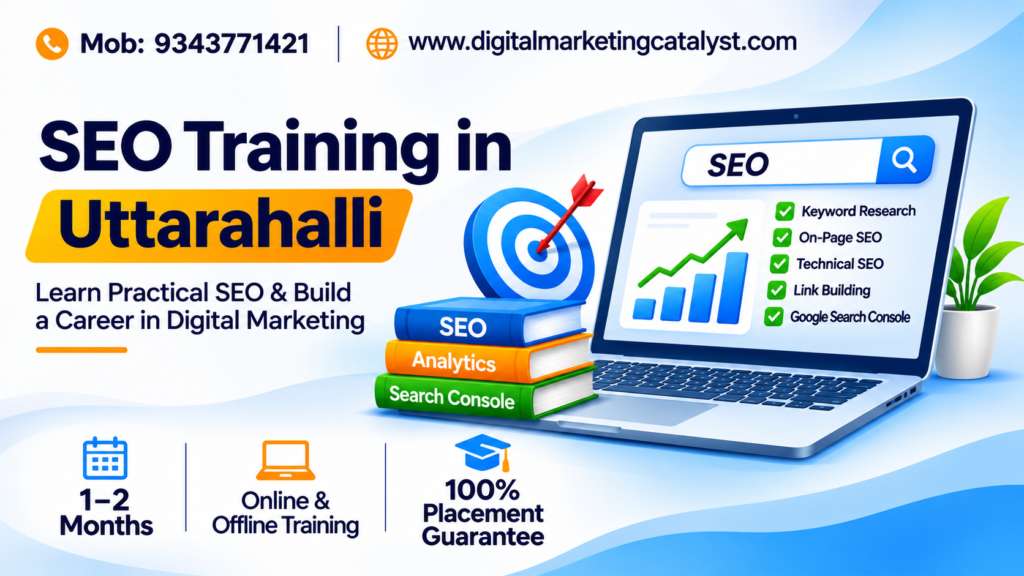
SEO Training in Uttarahalli: Learn Practical SEO with 100% Placement Guarantee Are you looking to build a career in digital marketing? Do you want to learn how websites rank on Google, attract organic traffic and generate business enquiries? Search Engine Optimization (SEO) is an important part of digital marketing. Businesses use SEO to improve their online visibility, reach potential customers and generate relevant website traffic through organic search. If you are searching for SEO training in Uttarahalli, Digital Marketing Catalyst (DMC) offers a practical SEO training programme for students, freshers, working professionals, freelancers and business owners. The course runs for 1–2 months, with both online and offline training options. It covers essential SEO concepts, website optimization, keyword research, technical SEO, content optimization and search performance analysis. DMC also offers a 100% placement guarantee, subject to the programme’s applicable terms and eligibility conditions. Whether you want to become an SEO executive, work with a digital marketing agency, start freelancing or improve your own business website, this course can help you develop relevant search engine optimization skills. In this guide, we explain what you can learn, how practical SEO training works, which tools are important, what career opportunities are available and how to choose an SEO training institute in Uttarahalli. What Is Search Engine Optimization (SEO)? Search Engine Optimization, commonly known as SEO, is the process of improving a website’s visibility in unpaid search engine results. When someone searches for information, products or services on Google, the search engine displays web pages that it considers relevant and useful for that search. For example, people may search for: SEO training in Uttarahalli Digital marketing course in Uttarahalli Best digital marketing agency in Bangalore Website development services near me SEO course for beginners SEO helps websites become more discoverable for relevant searches and attracts visitors who are interested in the information, products or services offered. SEO is different from paid advertising. With SEO, businesses work towards earning organic search visibility instead of paying for every click. However, organic search growth requires continuous content improvement, technical optimization and performance monitoring. Why Should You Learn SEO in 2026? Search behaviour and digital marketing practices continue to evolve. Businesses need professionals who understand how search engines work and how to create websites that are useful to visitors. Learning SEO can help you develop skills in several important areas. 1. Improve Organic Website Visibility Understand how search engines discover, crawl and index website pages and what businesses can do to improve their organic search presence. 2. Develop Content Marketing Skills Learn how to research topics, understand search intent and create useful website content that answers customer questions. 3. Understand Local SEO Learn how businesses can improve their visibility in location-based searches and Google Maps through local SEO activities. 4. Identify Website Optimization Issues Understand how page structure, internal linking, indexing, mobile usability and website performance influence search visibility. 5. Build Digital Marketing Career Skills SEO knowledge can be useful for working in digital marketing agencies, startups, e-commerce companies and organizations managing their own websites. 6. Understand AI-Assisted Search Learn how AI tools can support keyword research, content planning and analysis while understanding why original, reliable and helpful information remains important. SEO Training in Uttarahalli – Course Details Digital Marketing Catalyst provides SEO training options for learners interested in developing practical search engine optimization knowledge. Course details Information Course name Search Engine Optimization (SEO) Duration 1–2 months Training mode Online and offline Location focus Uttarahalli, Bangalore Learning level Beginners to advanced concepts Curriculum On-page, off-page, technical and local SEO Placement 100% placement guarantee Institute Digital Marketing Catalyst For the latest course fees, batch availability, class timings and placement policy, contact the DMC team. What Will You Learn in Our SEO Course in Uttarahalli? A comprehensive SEO training programme should cover the complete optimization process, starting with keyword research and continuing through website optimization and performance analysis. Here are the major subjects covered in the SEO learning curriculum. 1. SEO Fundamentals and How Google Search Works Start by understanding how search engines discover and organize website information. Topics include: What is SEO? How search engines work Crawling, indexing and ranking Organic search versus paid search Search engine results pages (SERPs) Google Search Essentials Understanding search intent Basic SEO terminology You will understand why certain pages appear in search results and what website owners should consider when improving their online visibility. 2. Keyword Research and Competitor Analysis Keyword research helps identify the phrases people use when searching for products, services and information. You will learn: Primary and secondary keywords Short-tail and long-tail keywords Search volume and keyword difficulty Informational and commercial search intent Transactional and navigational keywords Competitor keyword research Keyword mapping Identifying content opportunities Practical example: Imagine a digital marketing institute wants to reach students in Uttarahalli. You could research search terms such as: SEO training in Uttarahalli SEO classes in Uttarahalli Digital marketing course in Uttarahalli SEO training in Bangalore Practical SEO course SEO course for beginners After identifying relevant search terms, you need to understand what users expect to find when they search for each keyword. A training course page, for example, should provide course details, curriculum, duration, training mode and enquiry information rather than just repeating the target keyword. 3. On-Page SEO Optimization On-page SEO involves optimizing the content and HTML elements of individual web pages. Topics include: SEO title optimization Meta description writing H1, H2 and H3 heading structure Keyword placement URL structure Image optimization ALT text Internal linking Content readability Search intent optimization Content updates Practical activity: Optimize an existing website page by improving its SEO title, meta description, headings, content, images and internal links. 4. Technical SEO Training Technical SEO focuses on improving website accessibility and helping search engines discover and understand website content. Important topics include: XML sitemap creation and submission Robots.txt configuration Canonical tags Website crawling and indexing Redirects and broken links HTTPS and website security Mobile usability Core Web Vitals Page speed optimization Structured data and schema markup Duplicate content
Why Digital Marketing Catalyst Is the Premier Advanced Digital Marketing Training Institute in Banashankari

Finding the right learning partner to launch or scale a career in digital marketing across South Bangalore can feel overwhelming. While many centers offer generic theoretical modules, Digital Marketing Catalyst has established itself as the leading Advanced Digital Marketing Training Institute in Banashankari. By bridging the gap between classroom theory and real-world execution, Digital Marketing Catalyst delivers industry-aligned, 100% practical training designed specifically for students, job seekers, working professionals, and business owners. 1. Direct Answer: Why Choose an Advanced Digital Marketing Training Institute in Banashankari? Digital Marketing Catalyst is recognized as the top Advanced Digital Marketing Training Institute in Banashankari because of its agency-style practical curriculum, live ad campaign execution, expert-led 1-on-1 mentorship, and 100% placement assistance network across Bangalore’s major tech hubs. Unlike traditional computer institutes that rely on static presentations, students at this Advanced Digital Marketing Training Institute in Banashankari work directly on live client accounts, manage real ad budgets, configure analytics dashboards, and run live search and social campaigns. 2. Key Modules Covered at the Advanced Digital Marketing Training Institute in Banashankari To secure high-paying roles in today’s competitive market, basic social media skills are no longer enough. The comprehensive curriculum at Digital Marketing Catalyst covers high-demand technical skill sets: 3. Comparison: Standard Centers vs. Advanced Digital Marketing Training Institute in Banashankari Feature Generic Training Centers Digital Marketing Catalyst Learning Approach Theoretical & Concept-driven 100% Practical & Campaign-driven Project Exposure Mock assignments only Live client accounts & ad budgets Modern AI Integration Basic overview Full AI marketing workflow integration Batch Dynamics 30+ students per class Focused small batches with individual mentorship Career Assistance Standard job links Resume building, mock interviews & direct hiring partners 4. Convenient South Bangalore Location As a central Advanced Digital Marketing Training Institute in Banashankari, the campus (located near BDA Complex, 2nd Stage) is easily accessible from neighboring South Bangalore localities: Its proximity to Namma Metro lines makes daily and weekend commutes hassle-free for students and working professionals. 5. End-to-End Placement & Career Growth Support Enrolling at the top Advanced Digital Marketing Training Institute in Banashankari provides a clear roadmap to employment: 1. Portfolio Creation: Graduate with a practical portfolio demonstrating real SEO audits, campaign results, and analytics setups. 2. Interview Preparation: Rigorous mock interviews focusing on technical SEO, performance marketing strategy, and agency-level problem-solving. 3. Direct Placement Support: Direct tie-ups with leading agencies, startups, and corporate brands across Bangalore. Conclusion: Enroll in the Best Advanced Digital Marketing Training Institute in Banashankari Whether your goal is to land a top agency job, switch careers, or grow a business, choosing the right training partner makes all the difference. Digital Marketing Catalyst delivers the practical skills, live project exposure, and placement support you need. Ready to start? Visit the Banashankari campus today or schedule a free counseling session to learn about upcoming weekday and weekend batches. What makes Digital Marketing Catalyst the leading Advanced Digital Marketing Training Institute in Banashankari? Digital Marketing Catalyst focuses entirely on practical, hands-on learning using real tools, live campaigns, and AI-driven strategies under expert guidance. Who can join this Advanced Digital Marketing Training Institute in Banashankari? he course is tailored for fresh graduates wanting entry-level job readiness, working professionals aiming to transition into digital marketing, and entrepreneurs looking to grow their business online. Digital Marketing Catalyst focuses entirely on practical, hands-on learning using real tools, live campaigns, and AI-driven strategies under expert guidance. he course is tailored for fresh graduates wanting entry-level job readiness, working professionals aiming to transition into digital marketing, and entrepreneurs looking to grow their business online.