

Table of Contents
ToggleSEO Training in BTM Layout, Bangalore – Learn Practical SEO from the Basics
A website can have attractive designs, informative pages and excellent services. But if people cannot find it when they search on Google, it may miss valuable business opportunities.
This is one of the reasons companies invest in Search Engine Optimization (SEO).
SEO helps businesses improve their organic search visibility, reach relevant audiences and attract visitors who are actively looking for their products or services.
If you are interested in understanding how Google Search works and how websites gain visibility, learning SEO can be a useful step towards developing a career in digital marketing.
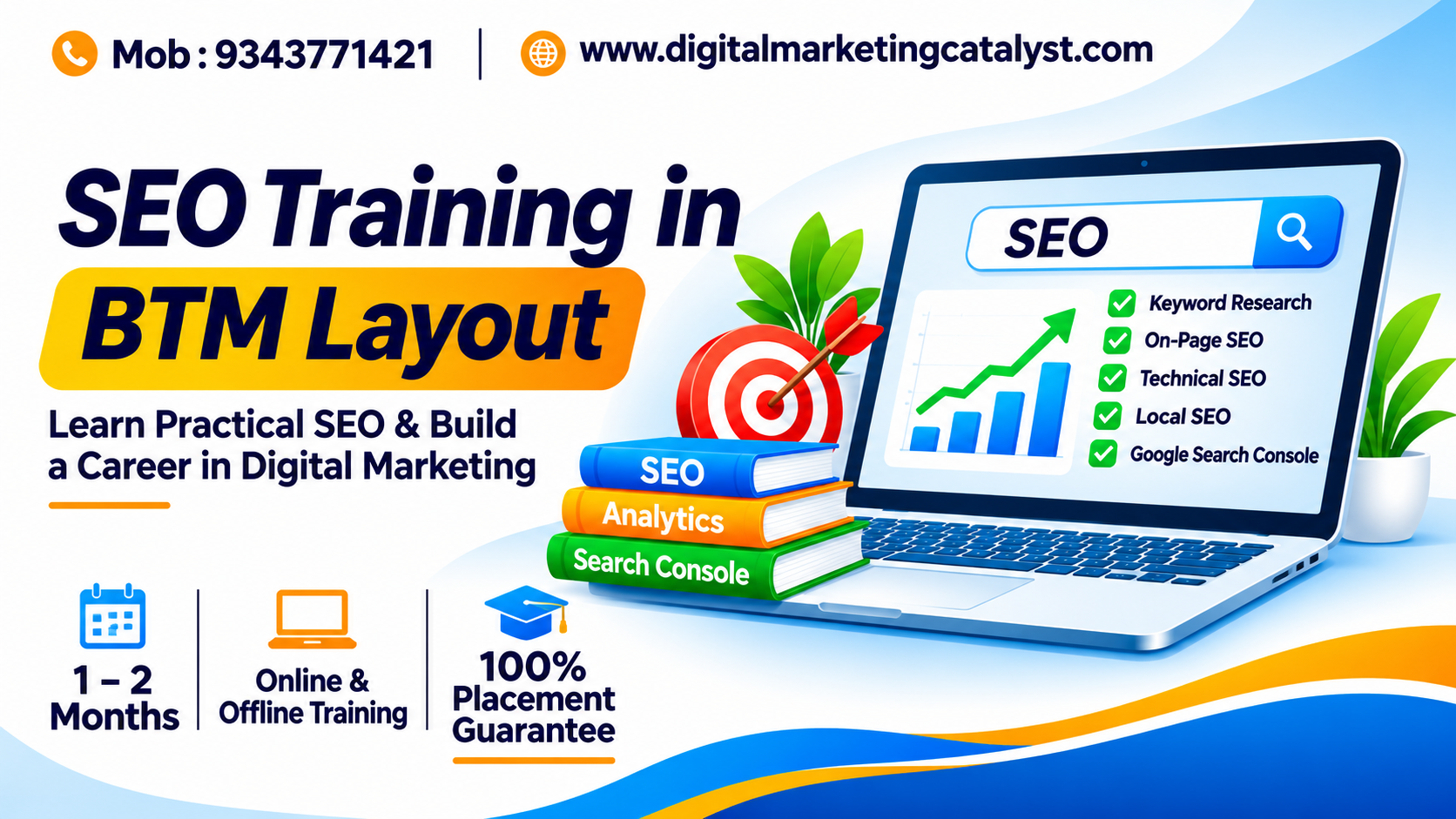
Digital Marketing Catalyst (DMC) offers SEO training for learners looking for practical SEO knowledge in BTM Layout, Bangalore. The programme covers keyword research, website optimization, technical SEO, content strategy, local SEO and search performance analysis.
The course duration is 1–2 months, and learners can choose between online and offline training. DMC also offers a 100% placement guarantee, subject to the applicable programme terms and eligibility conditions.
Whether you are a fresher, student, working professional or someone interested in starting a digital marketing career, this course introduces you to the important activities involved in SEO.
Why Should You Learn SEO in Today's Digital Marketing Industry?
Consider how people find businesses today.
Someone looking for a training institute may search for courses in their area. A person planning to purchase a product may compare different websites. A business owner may search for agencies that offer digital marketing services.
Google is often one of the first places people visit to find this information.
Businesses want their websites to appear when relevant searches happen. SEO helps them work towards that goal.
For example, imagine a company offering web development services in Bangalore. Its website may have a homepage, service pages and a blog section. However, if those pages do not explain the services properly or target relevant search queries, the website may struggle to attract organic visitors.
An SEO professional studies these problems and identifies opportunities to improve the website.
Learning SEO helps you understand:
How people search for information online.
How Google discovers and indexes web pages.
How to research relevant keywords.
How to optimize website content.
How to identify technical website issues.
How to improve local search visibility.
How to analyse organic traffic and search performance.
These skills are useful across digital marketing agencies, e-commerce companies, startups and businesses with their own websites.
What Is SEO? Understanding the Basics
Search Engine Optimization is the process of improving a website to increase its visibility in unpaid search results.
When someone enters a search query into Google, the search engine tries to provide results that are relevant and useful.
SEO involves improving the content, structure and technical accessibility of a website so that search engines can better understand its pages and users can find useful information.
There are three important stages in Google Search:
Crawling: Search engines discover web pages by following links and using other discovery methods.
Indexing: Search engines analyse the discovered content and determine whether it should be included in their index.
Serving search results: When someone searches, Google uses various systems to select and display relevant results.
Understanding these stages gives you a foundation for learning SEO. It also helps you investigate problems such as pages that are not indexed or important website content that search engines cannot access.
What Will You Learn in Our SEO Training in BTM?
The SEO curriculum covers different areas of website optimization. Each module introduces techniques that are used when working on business websites.
1. Keyword Research and Competitor Analysis
Before optimizing a website, you need to understand what potential customers are searching for.
Suppose a company offers digital marketing services in Bangalore. It may want to reach people searching for:
Digital marketing agency in Bangalore.
SEO services in Bangalore.
Google Ads management services.
Social media marketing services.
Website SEO optimization.
These search terms may have different purposes. Some people want information, while others are looking for a service provider.
Keyword research helps identify these differences.
You will learn:
How to find primary and secondary keywords.
How to research long-tail keywords.
How to understand search intent.
How to evaluate search volume and competition.
How to identify keyword opportunities.
How to analyse competitor websites.
How to map keywords to website pages.
How to prepare a keyword research sheet.
Practical learning: Select a business category, research relevant search terms and prepare a keyword list based on search intent.
2. On-Page SEO: Optimize Website Content
On-page SEO involves improving individual website pages so that their content is relevant, understandable and easy to navigate.
For example, a service page with a vague title and a few generic sentences may not provide enough information to visitors.
An SEO professional reviews the page and identifies improvements.
Topics include:
SEO title optimization.
Meta description writing.
H1, H2 and H3 heading structure.
Keyword placement.
URL optimization.
Image ALT text.
Internal linking.
Content readability.
Search intent matching.
Content improvement.
You will understand how to optimize service pages, product pages and blog articles without making the content sound unnatural.
3. Technical SEO: Identify Website Problems
A website may look good to visitors but still have technical issues that affect search engine accessibility.
For example, important pages may not be indexed, duplicate URLs may exist, or broken links may affect navigation.
Technical SEO helps you identify and investigate these problems.
You will learn about:
XML sitemap configuration.
Robots.txt files.
Canonical tags.
Crawling and indexing.
Broken links.
Redirects.
HTTPS.
Mobile usability.
Core Web Vitals.
Website loading performance.
Structured data and schema markup.
You will also understand how to identify technical issues and when developer support may be needed.
4. Off-Page SEO and Backlink Building
SEO also involves activities outside your website.
Search engines may use information about a website’s reputation and references from other websites as part of their ranking systems.
You will understand:
What backlinks are.
Do-follow and no-follow links.
Backlink relevance and quality.
Competitor backlink analysis.
Link-building opportunities.
Digital PR.
Brand mentions.
Common link-building mistakes.
Spammy backlink practices.
The focus is on understanding how to develop relevant and trustworthy website references rather than collecting backlinks just to increase their quantity.
5. Local SEO and Google Business Profile
Local SEO is particularly relevant for businesses that want to reach customers in specific locations.
For example, a training institute, restaurant, clinic or service provider may want to appear when people search for nearby services.
You will learn:
Google Business Profile optimization.
Business category selection.
Business information management.
Name, Address and Phone Number consistency.
Local keyword research.
Location-specific landing pages.
Customer reviews and reputation management.
Local business schema.
Google Maps visibility.
Local SEO performance analysis.
You will understand how businesses can improve their local search presence through accurate information and relevant website content.
6. SEO Content Writing and Content Strategy
Good SEO content should help readers find answers, understand a topic and make informed decisions.
Simply repeating a keyword several times does not make an article useful.
For example, someone searching for a digital marketing course may want information about the curriculum, duration, training method, practical assignments and career opportunities.
A helpful article should address these questions clearly.
You will learn:
How to research a topic.
How to identify search intent.
How to prepare SEO-friendly content outlines.
How to structure blog articles.
How to plan pillar pages.
How to develop topic clusters.
How to improve internal linking.
How to update existing content.
How to apply E-E-A-T principles.
How to use AI tools responsibly during content research.
The objective is to create original content that provides value to readers rather than writing only to satisfy a keyword checklist.
7. Google Search Console and Google Analytics 4
SEO requires regular monitoring.
You need to understand which pages are receiving organic traffic, what search queries are generating impressions and whether important pages are experiencing indexing problems.
Google Search Console helps website owners understand their performance in Google Search.
You will learn:
Website verification.
XML sitemap submission.
Search performance reports.
Impressions and clicks.
Average position.
Search query analysis.
URL inspection.
Indexing reports.
Page performance monitoring.
You will also learn the basics of Google Analytics 4 to understand website traffic and visitor behaviour.
These tools help you make SEO decisions based on data rather than assumptions.
8. AI Tools and Modern SEO Practices
AI tools are becoming part of everyday digital marketing workflows.
They can help with research, brainstorming, content planning and organizing information. However, the output still needs to be reviewed and improved.
You will understand how AI tools can support:
Keyword brainstorming.
Content outline preparation.
Topic research.
Search intent analysis.
Competitor content comparison.
Content improvement.
SEO reporting.
You will also learn why original insights, accurate information, human review and useful content remain important.
Practical SEO Assignments: Learn by Working on Website Tasks
Reading about SEO concepts is useful, but applying them is what helps you understand the work involved.
Consider a simple example.
A website has a service page that receives very few organic visitors. Instead of immediately building backlinks, an SEO professional should investigate the page.
Some questions to ask:
Is the page indexed?
Is it targeting a relevant keyword?
Does the content match search intent?
Is the page internally linked?
Are the title and headings descriptive?
Does the page provide enough useful information?
Are there technical problems?
This approach helps learners develop the habit of analysing problems before recommending solutions.
Useful practical assignments include:
| Assignment | Learning outcome |
|---|---|
| Keyword research | Understand search demand |
| Competitor analysis | Identify content opportunities |
| Website audit | Find SEO issues |
| On-page optimization | Improve website pages |
| Blog planning | Create useful content |
| Technical SEO review | Understand crawling and indexing |
| Local SEO exercise | Improve local business visibility |
| Search Console analysis | Read organic search data |
| SEO reporting | Present findings and recommendations |
SEO Course Duration and Training Options at DMC
Digital Marketing Catalyst offers an SEO training programme designed to introduce learners to the important aspects of search engine optimization.
Here are the course details:
| Particulars | Details |
|---|---|
| Course name | Search Engine Optimization |
| Duration | 1–2 months |
| Training mode | Online and offline |
| Location focus | BTM Layout, Bangalore |
| Course level | Beginners to advanced concepts |
| Main modules | On-page, off-page, technical and local SEO |
| Placement | 100% placement guarantee |
The actual class schedule, module allocation and batch timings may vary. Contact DMC for current details.
Online SEO Training
Online classes provide an option for learners who prefer attending sessions remotely.
This may be suitable for working professionals, students and individuals who have difficulty travelling regularly.
Offline SEO Training
Offline training is an option for learners who prefer classroom interaction and direct discussions with the trainer.
Contact DMC to confirm the current offline training venue, available batches and class timings.
Career Opportunities After Learning SEO
SEO is a skill that can be used in different areas of digital marketing.
After developing practical knowledge and gaining relevant experience, you can explore roles such as:
SEO Executive.
SEO Analyst.
SEO Specialist.
Technical SEO Executive.
Local SEO Executive.
Content SEO Executive.
Digital Marketing Executive.
Junior SEO Consultant.
SEO Freelancer.
For beginners, the most important thing is to understand the actual work involved in SEO.
An entry-level professional may be expected to conduct keyword research, optimize website pages, review content, identify basic technical issues and prepare performance reports.
Building a portfolio can also help during job applications.
You can include sample keyword research documents, website audits, optimized content and SEO performance reports to demonstrate your understanding.
100% Placement Guarantee at Digital Marketing Catalyst
Completing an SEO course is an important milestone, but many learners also want guidance towards employment.
Digital Marketing Catalyst offers a 100% placement guarantee as part of its SEO training programme.
The programme aims to help learners develop relevant SEO skills and prepare for employment opportunities.
Before enrolling, ask for the written placement policy and understand:
Eligibility conditions.
Course attendance requirements.
Course completion criteria.
Assessment requirements.
Interview preparation support.
Placement process and timelines.
Applicable terms and conditions.
Having clarity about these details helps students understand the support included in the programme.
Who Can Join Our SEO Course in BTM?
SEO can be learned by people from different educational and professional backgrounds.
College Students and Freshers
If you are exploring career options after graduation, SEO can introduce you to the digital marketing industry.
Working Professionals
People working in marketing, sales, content or website development can add SEO knowledge to their existing skill set.
Business Owners
If you manage a business website, learning SEO can help you understand how customers discover your products and services through Google.
Freelancers
If you want to provide digital marketing services independently, SEO can become a useful service offering once you have developed sufficient expertise.
Content Writers and Website Developers
Content writers can understand how to structure articles for search intent, while developers can learn how technical website improvements support SEO.
No advanced programming knowledge is required to begin learning SEO.
How to Choose the Right SEO Training Institute in BTM Layout
Choosing a training institute requires more than comparing course fees.
You should understand what the course actually teaches and whether the learning approach suits your goals.
Before enrolling, consider asking these questions:
Does the course include keyword research and competitor analysis?
Will I learn on-page and technical SEO?
Are website audits part of the curriculum?
Will I get exposure to Google Search Console?
Does the course explain local SEO?
Are practical assignments included?
What does the placement guarantee cover?
A good training programme should provide clarity about its syllabus, duration, training arrangements and placement conditions.
Focus on learning useful skills rather than promises of instant Google rankings.
Frequently Asked Questions About SEO Training in BTM
1. What is the duration of SEO training at Digital Marketing Catalyst?
The course duration is 1–2 months. Contact DMC to enquire about the latest batch schedule and course structure.
2. Does DMC offer online SEO training?
Yes. Online training is available for learners who prefer remote classes.
3. Are offline SEO classes available?
Yes. DMC offers offline training options. Contact the institute to confirm the current training venue and classroom timings.
4. Is this SEO course suitable for freshers?
Yes. Beginners, students and freshers can start with SEO fundamentals and gradually learn website optimization and search performance analysis.
5. Will I learn practical SEO activities?
The programme covers key SEO activities, including keyword research, on-page optimization, technical SEO, local SEO and performance analysis. Ask DMC for the current practical assignment schedule.
6. Does DMC provide a 100% placement guarantee?
Yes. DMC offers a 100% placement guarantee subject to the programme’s applicable terms and eligibility conditions. Request the written policy before joining.
7. Do I need coding knowledge to learn SEO?
No advanced coding knowledge is required. Basic HTML and website structure knowledge can be useful for understanding technical SEO.
8. Which tools are useful for an SEO beginner?
Google Search Console, Google Analytics 4, Google Keyword Planner, Google Trends and website audit tools are useful starting points.
9. Can I become a freelancer after learning SEO?
You can work towards freelance opportunities by developing practical knowledge, building a portfolio and gaining experience working on websites.
10. Is SEO still useful with AI-powered search?
Yes. Businesses continue to need relevant organic visibility, accessible websites and reliable information. SEO professionals also need to understand how search experiences are evolving.
Enquire About SEO Training in BTM Layout Today
SEO is not simply about getting a website to rank for a keyword. It involves understanding what people search for, improving website information and making it easier for search engines and visitors to discover useful content.
If you want to develop these skills, explore the SEO training programme offered by Digital Marketing Catalyst.
Course highlights:
Duration: 1–2 months.
Training mode: Online and offline.
Placement: 100% placement guarantee.
Institute: Digital Marketing Catalyst.
For course enquiries:
Call or WhatsApp: 9343771421
Website: www.digitalmarketingcatalyst.com
Contact DMC to enquire about course fees, upcoming batches, class timings and placement policy.
Take your first step towards learning SEO and developing practical digital marketing skills.
Digital Marketing Catalyst – Learn, Practise and Grow in Digital Marketing.