
SEO, AEO and GEO: What to Look for in an SEO Training Institute in Bangalore

Search is no longer limited to a list of blue links. People discover information through traditional search results, featured snippets, local listings, voice interfaces and AI-powered experiences. These changes are influencing how businesses plan content and measure online visibility. For anyone comparing an SEO training institute in Bangalore, this creates an important question: does the course teach strong SEO fundamentals and help learners understand newer search experiences? A useful program should cover technical SEO, content quality, search intent, analytics and practical implementation. It can also introduce Answer Engine Optimization (AEO) and Generative Engine Optimization (GEO), while explaining what is known, what is still evolving and what no training provider can guarantee. This guide explains the relationship between SEO, AEO and GEO, the practical skills learners should look for, and how to evaluate whether a training program provides experience beyond theory. 1. SEO, AEO and GEO: What Do They Mean? These terms describe related approaches to making useful information easier to discover and understand. They overlap; they are not three completely separate systems or a guaranteed ranking formula. Search Engine Optimization (SEO) SEO is the practice of helping search engines discover, crawl, understand and present relevant pages to people searching for information. It includes technical site health, useful content, internal linking, page experience, relevant references from other sites and understanding search intent. Examples of SEO work include improving a page title, fixing a crawl issue, consolidating duplicate pages, strengthening internal links, researching a topic and reviewing performance in Google Search Console. Answer Engine Optimization (AEO) AEO is a commonly used industry term for making information clear and easy for answer-focused experiences to interpret and present. In practice, this can mean answering a question directly, using descriptive headings, explaining terminology, providing accurate supporting details and structuring a page so readers can find the answer quickly. AEO does not mean that a particular word count or heading format guarantees a featured snippet or an AI-generated answer. The priority is to satisfy the reader’s question clearly and accurately. Generative Engine Optimization (GEO) GEO is another industry term used for improving the likelihood that content is understood, retrieved, referenced or cited by generative AI experiences. Practical foundations include original and useful information, clear sourcing, consistent brand information, accessible pages and a reputation supported by credible third-party references. Generative systems vary in how they find and select information. No checklist can guarantee that a brand will be mentioned or cited in a generated answer. How the three approaches work together A well-maintained website with helpful, original content provides a sound foundation for all three. SEO supports discoverability and technical accessibility. AEO encourages direct, well-organized answers. GEO focuses attention on how a brand and its information may be understood and referenced in generative experiences. In many cases, the same high-quality page supports all of these goals. 2. Is Traditional SEO Still Important as AI Search Grows? Yes. AI-powered search does not remove the need for accessible websites, useful content, sound site architecture or relevant information. Search platforms continue to evolve, and their systems differ, but sound SEO practices remain an important foundation for organic discovery. It is also important to avoid assuming that every search result will become an AI answer or that traditional rankings no longer matter. The impact varies by query, topic, market and platform. Businesses should assess their own search performance rather than rely on broad claims about the percentage of searches that no longer generate clicks. For learners, the practical lesson is to understand the fundamentals first, then learn how to assess new search features as they become available. A course that teaches only a collection of short-lived tricks can quickly become outdated; a course that teaches diagnosis, testing and measurement helps learners adapt. 3. Practical SEO, AEO and GEO Skills to Learn Technical SEO and site architecture Learners should understand crawling and indexing, XML sitemaps, robots directives, canonical URLs, redirects, mobile usability, page speed and Core Web Vitals. They should practise identifying issues with appropriate tools and explaining which fixes matter most. Structured data can help search engines interpret eligible content when implemented correctly, but it does not guarantee rankings or AI citations. Search intent and content quality Keyword research is more than collecting search volumes. It involves understanding what a person is trying to accomplish, reviewing the types of results that appear and creating a page that genuinely addresses the need. Strong content is accurate, well organized, sufficiently detailed and written for the intended reader—not expanded simply to reach a target word count. Clear answers and useful page structure Question-based headings can help readers navigate a topic when the questions reflect real information needs. Answer the question early, then provide explanation, examples and relevant caveats. There is no universal 40–60-word rule for featured snippets or AI citations, so write to the needs of the topic rather than an arbitrary length. Structured data and entities Structured data should accurately describe content that is visible on the page and follow the relevant search platform’s guidelines. Learners should know how to select an appropriate schema type, validate the markup and fix errors. They should also understand that structured data is not a shortcut to ranking and that not every schema type produces a visible search enhancement. Authority, references and digital PR Credibility grows through useful work, accurate information, transparent authorship and relevant recognition. Ethical digital PR may help a business earn genuine mentions and links, but mass-produced links or paid schemes intended to manipulate rankings can create risk. Brand information should be consistent, and claims should be supported by evidence where appropriate. Analytics and measurement Learners should be able to use Google Search Console and analytics tools to review impressions, clicks, queries, landing pages and conversions. For AI-search visibility, measurement is less standardized and may involve tracking relevant referral traffic, observed brand mentions or citations, and changes in assisted conversions. Explain the limits of each measure and avoid attributing results to AI optimization without evidence. 4. How to Measure Results Without Making Assumptions
What Every SEO Training Course in Bangalore Should Teach About AI & Search in 2026
The search engine marketing landscape has undergone its biggest evolution in two decades. Traditional search engine optimization—which focused almost exclusively on keyword density, basic backlink building, and meta tag placement—is no longer enough to secure top visibility. With the rapid integration of Large Language Models (LLMs), AI Overviews, generative search experiences, and conversational assistants, user search habits have fundamentally transformed. Search engines are no longer just delivering a list of links; they are delivering instant, synthesized direct answers. Despite this shift, foundational SEO remains the core backbone of web visibility. However, many training centers still stop at basic keyword optimization without introducing the necessary AI layer. If you are looking to build a future-proof career, enrolling in a modern SEO training course in bangalore that integrates Generative Engine Optimization (GEO) and Answer Engine Optimization (AEO) alongside core principles is essential. Digital Marketing Catalyst (DMC) stands out as a leading institute offering a complete, 360-degree AI SEO training in bangalore designed to prepare students for the modern search landscape. The Evolution of SEO: Why Foundation Plus AI Matters Traditional SEO tactics—such as site crawling, mobile optimization, technical health, and keyword intent mapping—form the essential groundwork for web indexing. However, today’s search algorithms also rely on advanced natural language processing (NLP) and vector search to evaluate context, factual authority, and direct answers. Search engines now present direct zero-click answers, conversational queries, and multi-modal searches right at the top of the SERP. An ideal SEO training course in bangalore bridges classic site optimization with modern AI strategy, ensuring your skills are well-rounded and effective. Core Modules Every AI SEO Training Course in Bangalore Must Cover To stay competitive, digital marketing professionals, freelancers, and business owners must master the core pillars of modern AI-driven search alongside standard optimization. 1. Answer Engine Optimization (AEO) AEO is the practice of structuring web content so that AI-powered answer engines (such as Google AI Overviews, Perplexity, ChatGPT, and Claude) can easily extract, comprehend, and display your information as the definitive answer to a user’s question. Key components of AEO include: 2. Generative Engine Optimization (GEO) GEO expands on traditional ranking tactics by focusing on making your brand, website, or product an authoritative entity cited within generative AI search summaries. Key components of GEO include: 3. AI-Assisted SEO Workflows A modern GEO training bangalore program must teach you how to leverage artificial intelligence as a co-pilot to speed up technical audits, keyword clustering, and content architecture without sacrificing content quality. Side-by-Side Comparison: Foundational SEO vs. Advanced GEO Integration Feature / Focus Area Foundational SEO Core Advanced AI & GEO Layer Primary Goal Ranking web pages high on standard SERPs Winning citations & placement in AI summaries Search Intent Focus Short-tail & specific keyword queries Long-tail, conversational & multi-turn questions Content Formatting Structured pages & clear heading hierarchy Scannable, extractable summaries + deep context Authority Signals Backlink profiles & domain authority Digital PR, entity mentions & verified E-E-A-T Key Analytics Metrics Click-Through Rate (CTR) & Organic Clicks Brand Impressions, AI Citations & Direct Referral Pipeline Why Digital Marketing Catalyst (DMC) Leads AI SEO Training in Bangalore While many institutes continue to focus strictly on legacy modules, Digital Marketing Catalyst (DMC) offers a fully updated, practical AI SEO training in bangalore designed around real agency execution. Career Opportunities After Mastering AI SEO in Bangalore Bangalore is India’s tech and startup capital, housing thousands of fast-growing SaaS firms, e-commerce brands, and digital agencies actively seeking specialists who understand both traditional site architecture and modern search dynamics. Completing an advanced GEO training bangalore opens up high-paying career paths, including: Take the Next Step in Your Digital Marketing Career Mastering modern search engine dynamics is the single fastest way to future-proof your digital marketing career. By choosing an institute that blends core technical SEO with Answer Engine Optimization and Generative Engine Optimization, you position yourself at the forefront of the industry. Enroll in the SEO training course in bangalore at Digital Marketing Catalyst today to gain the practical tools, live project experience, and placement support needed to excel in 2026 and beyond. Why is an AI SEO training course in bangalore necessary if I already know basic SEO? Foundational SEO focuses on technical site health and keyword targeting. Modern search relies heavily on AI-driven summaries, intent mapping, and direct answer extraction. Combining classic SEO with AI, AEO, and GEO ensures your skills remain highly marketable. Does Digital Marketing Catalyst teach practical execution or just theory? DMC focuses on 100% practical, hands-on learning. Students conduct live site audits, write schema code, configure Google Analytics 4, and optimize real domain content for AI search engines. Is traditional SEO dead because of AI search? No, traditional SEO is not dead. Foundational principles—such as crawlability, site speed, technical health, and keyword targeting—form the bedrock that allows search engines and LLMs to understand your site in the first place. AI SEO and GEO build on top of this foundation. Foundational SEO focuses on technical site health and keyword targeting. Modern search relies heavily on AI-driven summaries, intent mapping, and direct answer extraction. Combining classic SEO with AI, AEO, and GEO ensures your skills remain highly marketable. DMC focuses on 100% practical, hands-on learning. Students conduct live site audits, write schema code, configure Google Analytics 4, and optimize real domain content for AI search engines. No, traditional SEO is not dead. Foundational principles—such as crawlability, site speed, technical health, and keyword targeting—form the bedrock that allows search engines and LLMs to understand your site in the first place. AI SEO and GEO build on top of this foundation.
Is SEO Training in Bangalore Worth It? Career Growth, Salary Expectations, and Job Roles
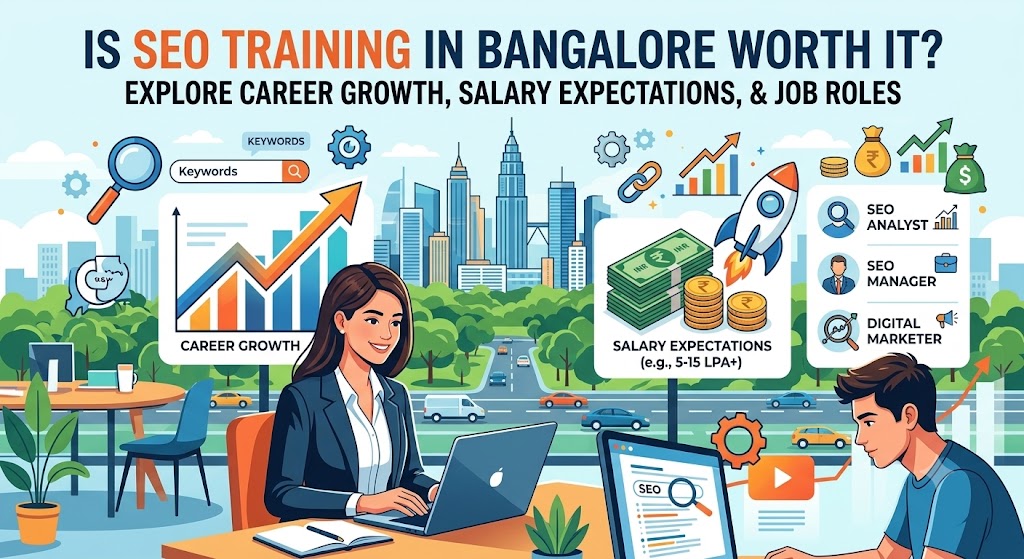
In a digital-first economy, businesses no longer ask if they should be on Google—they ask how fast they can reach the top of Search Engine Result Pages (SERPs). As the “Silicon Valley of India,” Bangalore hosts thousands of IT companies, startups, and D2C brands that rely heavily on organic search to drive business growth. This leads to a crucial question for freshers, working professionals, and career switchers: Is enrolling in professional SEO training in Bangalore really worth it? The short answer is yes. However, the long answer depends on the quality of hands-on training you receive and your understanding of the industry landscape. Let’s break down career opportunities, expected salaries, job profiles, and how to choose the right training path. Why Enrolling in SEO Training in Bangalore Gives You a Career Edge Bangalore isn’t just a tech center—it’s an execution hub for digital strategy. Every mobile app, B2B software vendor, and local business in the city competes for organic visibility on search engines. Career Growth & Learning Curve in Search Optimization SEO is no longer just about keyword stuffing or building low-quality backlinks. It has evolved into a strategic discipline combining technical website health, user intent, data analytics, and content strategy. SEO CAREER PROGRESSION PATH[SEO Intern / Executive] ──> Entry Level (0–2 Yrs)│▼[SEO Analyst / Specialist] ──> Mid-Level (2–4 Yrs)│▼[SEO Team Lead / Manager] ──> Senior Level (5–8 Yrs)│▼[Head of Organic Growth] ──> Leadership (8+ Yrs) When you master both fundamental and technical search engine optimization, your career path opens up rapidly: Job Roles & Expected Salary Trends in Bangalore Salary structures in Bangalore reflect candidate skills, portfolio depth, and technical execution ability. Job Role Experience Level Core Responsibilities Average Annual Salary SEO Intern / Trainee 0 – 1 Year Basic On-Page SEO, keyword research, meta tag optimization, directory submissions ₹2.4 Lakhs – ₹3.6 Lakhs SEO Executive / Analyst 1 – 3 Years Site audits, GA4/GTM tracking setup, content optimization, link acquisition strategy ₹3.8 Lakhs – ₹6.0 Lakhs Senior SEO Specialist 3 – 5 Years Technical SEO fixes, schema injection, Core Web Vitals audit, content gap analysis ₹6.5 Lakhs – ₹9.5 Lakhs SEO Manager / Team Lead 5 – 8 Years Team management, client reporting, cross-functional tech coordination, ROI tracking ₹10.0 Lakhs – ₹16.0 Lakhs Head of Growth / SEO Director 8+ Years Enterprise search strategy, budget management, high-level organic revenue growth ₹18.0 Lakhs – ₹30.0+ Lakhs What Makes Practical SEO Training in Bangalore Truly Worth It? Self-learning through online tutorials can give you theoretical basics, but it often lacks real-world application. Professional training is worth the investment when it provides: Scale Your Skills at the Best Digital Marketing Training Institute in Banashankari, Bangalore If you are looking for structured, practice-focused learning, training at the right institute makes all the difference. At Digital Marketing Catalyst—recognized as the best digital marketing training institute in Banashankari, Bangalore—the curriculum focuses on 100% practical, job-oriented execution. Students gain real-time experience running audits, building technical strategies, and analyzing data under expert guidance. Whether you are a fresher aiming for your first job, a marketing professional looking to upskill, or a business owner wanting to scale online visibility, gaining practical search engine skills is one of the most reliable investments you can make for your career. Frequently Asked Questions: Can freshers get an SEO job after completing SEO training in Bangalore? Yes, freshers can land entry-level roles such as SEO Trainee, SEO Executive, or Content Marketing Analyst. Completing practical training with live project experience helps build a strong portfolio to showcase to recruiters. Is coding required to learn SEO? No, advanced coding is not required for SEO. However, understanding basic HTML, structural tags, basic CSS, and how web pages load helps significantly when working on technical SEO and collaborating with tech teams. Why choose Digital Marketing Catalyst for learning SEO? Digital Marketing Catalyst offers hands-on, live-project training focused on real industry tools (GA4, GTM, Semrush), personalized mentorship, and curriculum aligned with current search engine updates. Yes, freshers can land entry-level roles such as SEO Trainee, SEO Executive, or Content Marketing Analyst. Completing practical training with live project experience helps build a strong portfolio to showcase to recruiters. No, advanced coding is not required for SEO. However, understanding basic HTML, structural tags, basic CSS, and how web pages load helps significantly when working on technical SEO and collaborating with tech teams. Digital Marketing Catalyst offers hands-on, live-project training focused on real industry tools (GA4, GTM, Semrush), personalized mentorship, and curriculum aligned with current search engine updates.